How to Build a Boxing Ring: Regulation Sizes, Engineering, Ropes and India Costs
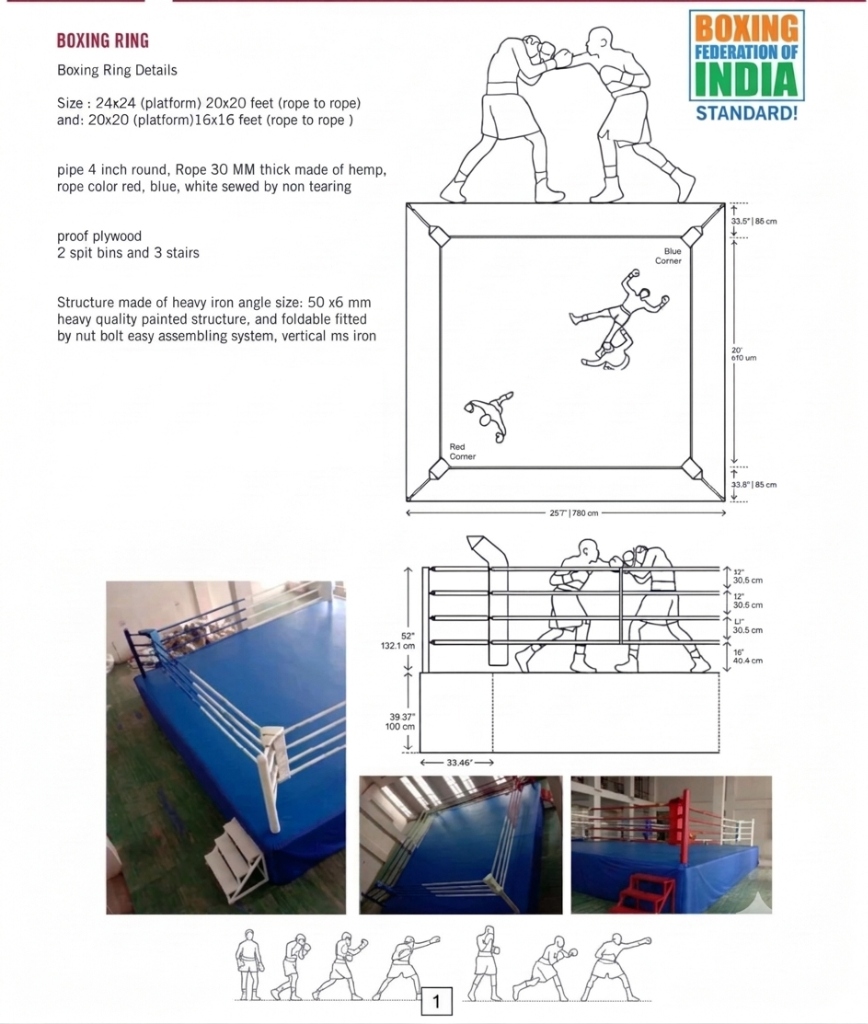
Standard Ring Dimensions & Governing Bodies
Boxing ring sizes vary between training gyms, Olympic amateur governing bodies (IBA, World Boxing, Boxing Federation of India - BFI), and professional sanctioning organizations (WBC, WBA, IBF, WBO).
- ▪ Inside Ropes vs Outer Platform: Ring size is properly specified by two measurements: the outer platform footprint and the inner fighting area bounded inside the ropes.
- ▪ Championship Standard (24 ft × 24 ft Outer / 20 ft × 20 ft Inside): Required for sanctioned title fights and major national tournaments. Provides 400 square feet of inner canvas, allowing stick-and-move boxers sufficient room to circle away from heavy punchers.
- ▪ International Amateur Spec (25.6 ft × 25.6 ft / 7.8m × 7.8m Outer): Conforms with top Olympic and World Boxing tournament specifications with extended 85cm outer perimeter aprons.
- ▪ Gym & Club Models (12 ft to 18 ft Outer): Compact setups designed for routine gym sparring, youth training, and cardio boxing where space optimization is critical.
Platform Elevation, Decking & Apron Clearance
A boxing ring is subject to continuous rhythmic footwork, pivots, and fighter impacts:
- ▪ Floor-Level Rings (Ground Level): Mounted directly to concrete or wooden gym sub-floors with perimeter tubular framing. Popular for fitness clubs because they eliminate elevation fall risks and conserve vertical ceiling height.
- ▪ Low Elevated Rings (45 cm to 60 cm / 1.5 ft to 2 ft): Offers elevation aesthetics and coach eye-level observation while requiring only two steps for entry.
- ▪ Championship Elevated Platforms (100 cm / 3.3 ft): The mandatory height for sanctioned pro boxing and BFI championships. The 100 cm platform elevates fighters above ringside officials, scorekeepers, timekeepers, and ring-announcers.
- ▪ Ring Apron Clearance: Regulation rings require an apron extending at least 45 cm to 85 cm (18 to 33 inches) beyond the rope line. This apron prevents boxers who get knocked through the ropes from plummeting to the arena floor.
Sub-Floor Impact Padding & Canvas Mat
The acoustic feedback and impact absorption of a ring define the fighter experience:
- 1 Structural Timber Deck: 25mm to 30mm thick marine-grade cross-bonded plywood or seasoned tongue-and-groove pine planks supported by transverse steel joists every 400mm to eliminate deck sag.
- 2 Impact-Absorbing Under-Pad: High-density closed-cell EVA or bonded felt-foam padding (20mm to 25mm thickness, minimum 200 kg/m³ density). It must be firm enough to prevent ankle roll during explosive lateral shifts, yet soft enough to pass Head Injury Criterion (HIC) tests during knockdowns.
- 3 Heavy-Duty Non-Slip Canvas: 18oz to 22oz heavy-weave cotton duck canvas. Canvas absorbs sweat without becoming slick, providing essential traction for leather-soled boxing boots. The canvas is tensioned through perimeter brass grommets with heavy bungee or ratchet cords under the apron.
The 4-Rope System, Turnbuckles & Spacers
Modern safety standards mandate a 4-rope configuration (vintage 3-rope designs are obsolete due to fighter head entrapment risks):
- ▪ Rope Diameters & Construction: 30mm to 40mm thick steel aircraft cable (minimum 6mm to 8mm 7×19 core) wrapped in high-density tubular foam and encased in smooth non-abrasive vinyl or velvet covers.
- ▪ Official Rope Heights (measured from canvas):
- ▪ - Rope 1 (Bottom): 40 cm (15.7 in)
- ▪ - Rope 2: 71 cm (28 in)
- ▪ - Rope 3: 102 cm (40 in)
- ▪ - Rope 4 (Top): 132 cm (52 in)
- ▪ Vertical Rope Spacer Straps: 8 heavy canvas or nylon straps (2 per side) vertically lock the 4 ropes together, preventing ropes from spreading apart when a boxer is driven against them.
- ▪ Turnbuckles & Tensioning: Heavy-duty M20 or M24 forged steel turnbuckles connect each rope to the corner post, protected by thick wrap-around padded covers.
Corner Pads, Posts & Corner Stairs
The ring corners dictate both safety and bout operation:
- ▪ Corner Post Specifications: 4 vertical corner posts made from heavy structural steel pipe (minimum 100mm / 4-inch OD with 4mm wall thickness). Under tension, the ropes exert inwards forces exceeding 3,000 kg; posts must be cross-braced to avoid inward bending.
- ▪ Corner Cushion Color Coding:
- ▪ - Red Corner: 1 Red Pad (assigned to the higher-seeded boxer)
- ▪ - Blue Corner: 1 Blue Pad (assigned to the visiting boxer)
- ▪ - Neutral Corners: 2 White Pads (where fighters must wait during knockdowns)
- ▪ Access Stairs: Elevated rings require 3 sets of stairs: Red Corner (fighter/coaches), Blue Corner (fighter/coaches), and Neutral Corner (Doctor, Referee, Ring Girls).
Step-by-Step Build Overview
A systematic approach to assembling a modular competition boxing ring:
- 1 Chassis Squaring: Position the 4 corner post assemblies and connect the outer perimeter box beams. Verify diagonal measurements are identical to ensure a true square.
- 2 Cross-Beam & Joist Interlocking: Lock internal structural support joists in place.
- 3 Deck Laying: Secure tongue-and-groove decking panels with countersunk screws.
- 4 Padding Placement: Lay high-density foam sheets edge-to-edge, taping seams with reinforcing vinyl tape.
- 5 Canvas Stretching: Position canvas centrally, stretch uniformly, and lash under-apron eyelets with ratcheted lacing cords.
- 6 Rope Rigging: Anchor turnbuckles, thread cables through vinyl covers, and tension each rope to regulation rigidity.
- 7 Corner Pad & Spacer Fitting: Strap on the color-coded corner bumpers and lock the 8 vertical anti-spread rope straps in place.
Training Ring vs Competition Ring Comparison
Understanding key architectural differences helps gym managers choose the right specification:
| Feature / Metric | Training / Club Ring | Official Competition Ring |
|---|---|---|
| Outer Platform Dimensions | 12×12 ft to 18×18 ft | 20×20 ft to 25.6×25.6 ft |
| Inner Fighting Dimensions | 10×10 ft to 16×16 ft | 18×18 ft to 20×20 ft |
| Platform Height | Floor Level (0 cm) to 60 cm Low | 100 cm (approx. 3.3 ft) High |
| Rope Count | 3 to 4 Ropes | Strictly 4 Ropes (Steel Core) |
| Apron Width | 30 cm – 45 cm | Minimum 50 cm – 85 cm Clearance |
| Access Stairs | 0 to 1 Set | 3 Independent Staircases |
| Sanctioning Suitability | In-house sparring, daily fitness | BFI, World Boxing, WBC/WBA Bouts |
Boxing Ring Costs in India (INR Ranges)
Fighter Forge manufactures boxing rings domestically in India to international specifications, providing substantial cost savings over European imports:
| Ring Model & Spec | Outer Footprint | Platform Elevation | Standard Price Range (INR) | Ideal Use Case |
|---|---|---|---|---|
| Floor Boxing Ring | 12 ft × 12 ft | Ground Level (0 cm) | ₹1.40 L | Small studio, boutique boxing gym |
| Floor Boxing Ring | 14 ft × 14 ft | Ground Level (0 cm) | ₹1.50 L | Standard training facility |
| Floor Boxing Ring | 16 ft × 16 ft | Ground Level (0 cm) | ₹1.70 L | Commercial combat gym |
| Low-Profile Ring (1-2 ft) | 12 ft × 12 ft | 45 cm – 60 cm High | ₹2.00 L | Elevated aesthetic for compact gym |
| Low-Profile Ring (1-2 ft) | 14 ft × 14 ft | 45 cm – 60 cm High | ₹2.20 L | Medium-sized boxing academy |
| Low-Profile Ring (1-2 ft) | 16 ft × 16 ft | 45 cm – 60 cm High | ₹2.40 L | Competitive sparring club |
| Low-Profile Ring (1-2 ft) | 18 ft × 18 ft | 45 cm – 60 cm High | ₹2.60 L | Large training gym |
| Low-Profile Ring (1-2 ft) | 20 ft × 20 ft | 45 cm – 60 cm High | ₹3.10 L | State tournament host club |
| Championship Pro Ring (3 ft) | 16 ft × 16 ft | 100 cm High | ₹2.65 L | Compact arena setup |
| Championship Pro Ring (3 ft) | 18 ft × 18 ft | 100 cm High | ₹2.90 L | Regional championship platform |
| Championship Pro Ring (3 ft) | 20 ft × 20 ft | 100 cm High | ₹3.70 L | Official BFI / Pro fight night |
| Championship Pro Ring (3 ft) | 24 ft × 24 ft | 100 cm High | ₹3.95 L | Full-scale pro championship |
| Championship Competition (3 ft) | 25.6 ft × 25.6 ft | 100 cm High | ₹4.25 L | International World Boxing standard |
Structural Safety, Rigidity & Maintenance
A boxing ring is an athletic apparatus under continuous mechanical tension:
- ▪ Turnbuckle Tension Verification: Check rope tension weekly. A slack top rope fails to rebound a fighter and can cause an athlete to tumble backwards over the ropes.
- ▪ Post Deflection Checks: Inspect corner post welds for hairline fatigue cracks every month.
- ▪ Canvas Sanitization: After every sparring session, mist the canvas with anti-fungal disinfectant solution and allow to dry completely to prevent athlete ringworm infections.
FREQUENTLY ASKED QUESTIONS
What size is an official boxing ring?
Under international governing bodies (such as BFI, World Boxing, and pro sanctioning bodies), an official championship boxing ring measures 24ft × 24ft outer platform with 20ft × 20ft inside the ropes. International Olympic formats often use a 25.6ft × 25.6ft outer platform with an 85cm outer apron.
How many ropes does a modern boxing ring have?
Modern boxing safety regulations mandate strictly 4 ropes. Old 3-rope rings have been discontinued across sanctioned competition because fighters risked falling between widely spaced ropes or getting caught by the neck.
How high is a regulation boxing ring platform?
An official competition boxing ring platform is 100 cm (approximately 3.3 feet / 39.4 inches) above the arena floor. Training rings in gyms are frequently floor-level (0 cm) or low-profile (45 cm to 60 cm) to conserve ceiling height.
How much does a boxing ring cost in India?
In India, a basic floor-mounted boxing ring costs between ₹1.40 Lakh and ₹1.70 Lakh. Low-profile elevated rings (1-2 ft) range from ₹2.00 Lakh to ₹3.10 Lakh, while full 100cm championship elevated rings (20ft to 25.6ft) range from ₹3.70 Lakh to ₹4.25 Lakh.
How thick should the padding be under the boxing canvas?
Regulation boxing rings require 20mm to 25mm of high-density closed-cell EVA or bonded felt-foam padding beneath the canvas to absorb athlete falls while preserving firm footing for rapid pivots.
RELATED STORIES & KNOWLEDGE
How to Build an MMA Cage: Dimensions, Materials, Costs and Construction Guide
READ STORY →
Best Boxing Gloves: Complete Buyer's Guide by Weight, Material and Price
READ STORY →